! STOP BENDING NOW !

Sunday, 21 April 2019

Scientist cures her constant back pain by taking up BELL-RINGING at church

  • Natalie Bleackley was diagnosed with idiopathic scoliosis condition as a child 
  • Severe back stiffness made her uneasy about going on walking holidays 
  • She goes to St Mary and St Nicholas in Leatherhead, Surrey, twice a week to cure
A scientist who suffered a lifetime of back pain has cured herself by bell-ringing.
Natalie Bleackley was diagnosed with the back condition idiopathic scoliosis as a child and underwent surgery for her curved spine.
But, by the time she reached her 30s, she experienced constant pain in the lower spine.
Severe back stiffness made her uneasy about going on walking holidays, rock climbing and canoeing, all activities she had enjoyed before.
Natalie Bleackley was diagnosed with the back condition idiopathic scoliosis as a child and underwent surgery for her curved spine


Natalie Bleackley was diagnosed with the back condition idiopathic scoliosis as a child and underwent surgery for her curved spine


The mother of two makes sure she goes to St Mary and St Nicholas in Leatherhead, Surrey, twice a week


The mother of two makes sure she goes to St Mary and St Nicholas in Leatherhead, Surrey, twice a week


Then in 2014 her daughter Jemima saw an advert for a 'taster day' at their local church. 
Mrs Bleackley went along and at first the 49-year-old did not feel any improvement. But a few months later her condition had miraculously improved.
'I was walking down the street one day and I realised that the pain had completely vanished,' she said.


'I think the regular action of pulling down on the bell ropes and then being pulled up by them has stretched out my back and somehow fixed whatever it was that was causing me the pain for all those years.' 
The mother of two makes sure she goes to St Mary and St Nicholas in Leatherhead, Surrey, twice a week.
She added: 'It never occurred to me before I decided to give bell-ringing a go that this might have a benefit for my back. I just saw it as a social activity.

She never thought that bell ringing would alleviate her back pain but just saw it as a social activity (pictured with her mother Ann Steed, left, and her daughter Jemima, right)


She never thought that bell ringing would alleviate her back pain but just saw it as a social activity (pictured with her mother Ann Steed, left, and her daughter Jemima, right)

In 2014 her daughter Jemima (right) saw an advert for a 'taster day' at their local church

In 2014 her daughter Jemima (right) saw an advert for a 'taster day' at their local church

'The fact that it has helped to cure a lifelong health problem has been both amazing and unexpected.'
The mother of two, who works as a clinical scientist at the Royal Marsden Hospital in Sutton, first suffered back problems at the age of 12.
She noticed she had developed a 'hump' at the top of her spine one day while looking at her hair in a mirror.
Doctors told her that her spine had curved to one side as a result of a growth spurt and she had a five-hour spinal fusion operation, similar to the one golfer Tiger Woods underwent.
Surgeons fused some of her vertebrae together by placing an additional section of bone in the space between them, helping to strengthen and realign her back.


Mrs Bleakley said: 'It can be quite scary at first because these bells, of which there are ten at St Mary and St Nicholas (pictured), are extremely heavy'


Mrs Bleakley said: 'It can be quite scary at first because these bells, of which there are ten at St Mary and St Nicholas (pictured), are extremely heavy'


Mrs Bleackley went along to bell-ringing classes and at first the 49-year-old did not feel any improvement but a few months later her condition had miraculously improved


Mrs Bleackley went along to bell-ringing classes and at first the 49-year-old did not feel any improvement but a few months later her condition had miraculously improved

She started secondary school wearing a plaster cast around her torso for nine months to stabilise her spine as she grew.
But a few years later she began to suffer intermittent sharp pain at the nape of her neck and base of her spine and the condition worsened.
But it seems making bells peel is the perfect antidote.
Mrs Bleackley, who lives in Ashtead, Surrey with her husband John, 53 and their other daughter Maddie added: 'It can be quite scary at first because these bells, of which there are ten at St Mary and St Nicholas, are extremely heavy, with the smallest weighing around 400kg.
'It's a real physical challenge being able to control the bells, as well as a mental one, playing in a band with nine other people.
'I really took to that, along with the social aspect of playing as a group.'
The NHS says idiopathic scoliosis cannot be prevented and is not thought to be linked to bad posture, exercise or diet


Source : Daily Mail Online , 20th April 2019 

Sunday, 7 April 2019

FDA clears first molybdenum rhenium pedicle screw

The FDA today cleared Mirus‘s Europea pedicle screw system, which is composed of its MoRe proprietary molybdenum rhenium superalloy, making it the first such device approved with the new class of implant material.
The Atlanta-based medical device company said that the MoRe proprietary alloy is intended to provide improved strength, ductility, durability and biological safety.
“Spine deformity surgery in adults remains plagued by the poor performance of current implants with rod failure occurring in 18%-20% of patients. The MoRe alloy shows great promise in improving the durability of adult spine deformity constructs. This advance will help prevent early revision surgery and improve outcomes in adult deformity surgery in particular,” Dr. Munish Gupta of Washington University said in a press release.
“This new material with its greater strength, fatigue resistance and superior biological properties will allow us to make lower profile foot and ankle implants leading to smaller surgical exposures and reduced revision rates,” Dr. James Nunley of Duke University said in a prepared statement.
Mirus added that it believes the MoRe alloy will allow for a new generation of smaller, stronger, more durable and bio-friendly implants which it hopes will result in less tissue disruption, faster recovery and improved patient outcomes.
“FDA approval of the Europa Pedicle Screw System with our patented MoRe superalloy is the culmination of over ten years of research and development.  Our scientists and engineers working with world class metallurgists have created the greatest advance in medical implant material technology in at least four decades. The MoRe superalloy will revolutionize many aspects of the medical device industry as the first alloy approved by the FDA for use in an implant which is not based on titanium, cobalt or iron with their inherent limitations. The FDA requires a rigorous level of scientific investigation to establish the safety and effectiveness of a spine implant that utilizes a new medical alloy. In response to FDA guidance, our scientific team led by Jordan Bauman, VP of Regulatory, developed a comprehensive body of evidence which served as the basis for approval of this major advance in patient care. We are fortunate to be collaborating with an outstanding worldwide group of orthopaedic and neurosurgeons in developing transformative spine solutions. Additionally, MiRus is rapidly expanding into other orthopaedic applications such as foot and ankle and has made significant progress in cardiovascular applications of the MoRe® superalloy,” founder & CEO Dr. Jay Yadav said in prepared remarks.

Source : Massdevice ,  27 March 2019


3D printing makes spine surgery easier


3D printing makes spine surgery easier


An orthopedic surgeon from All India Institute of Medical Science (AIIMS) has developed 3D printing technology for complex orthopedic, spinal and reconstructive surgeries while saying it can help to reduce complications significantly, apart from aiding in difficult cases. With the help of the 3D images from the CT scan, expert can develop the stereolithograpy of the damaged bone. This can be of great assistance to doctors because even a minor mistake or miscalculation during the correction of the spine deformity can cause paralysis or deformity," said Dr Bhavuk Garg. He also added with use of these "navigational template fit the vertebra perfectly' and provide a great assistance to the surgeon to avoid any single mistakes.

"Spinal deformities are usually associated with significant morbidity and mortality. These problems are very challenging to treat and have a great risk of neurologic complications because of hardware placement during corrective surgery. After the introduction of pedicle screws, scoliosis correction surgeries have witnessed a revolutionary shift, necessitating the placement of a screw within the pedicle with accuracy and safety," he said.


This precision is essential to avoid potential complications because of small bone geometry and the juxtaposition to the spinal cord, he added. "Surgical time was significantly less in the 3D printing group compared with the freehand group , moreover blood loss was higher in the freehand group but not statistically significant, Dr Garg added. He also said that we found a statistically significant higher rate of accurate screw positioning with 3D printing. In spite of a similar vertebral fusion span, more screws were inserted in the 3D printing group, which was possible because of enhanced safety, particularly at apical levels. "Soft tissues have to be stripped completely to make templates fit. Preoperative preparation of these templates takes around 10–12 hours per patient; however, the preoperative preparation is justified in view of statistically significant less surgical time and radiation exposure. Because bigger and less rotated pedicles do not require much surgical expertise and time compared with difficult ones, we are now using this technique only for difficult pedicles to save time and cost," he added. 


Source : Millennium Post , 31 March 2019 

Exercise-based physical therapy method helps people with scoliosis


April Gerard had been a physical therapist for decades when she discovered a treatment method that helped with her own scoliosis.
Now, she's using the same method to help her patients.
"I was always in front of the class showing off my terrible spine or my bad knees," said Gerard, 63, who practices at the St. Luke's Mount Royal Medical Clinic.
Once a top downhill skier — she was 13th in the country in 1968 — Gerard was diagnosed with scoliosis, a curvature of the spine most often found in females, at age 13. The condition, which affects 2-3 percent of the population, can cause an awkward posture and chronic pain and in some cases requires a back brace or surgical spinal fusing.
With help from exercises taught by a physical therapist, Gerard was able to avoid a back brace and continue skiing. But as she proceeded in her own career, she wondered if there was something better for herself and her patients.
She looked in the same place you might look.
"I googled it," Gerard said.
She learned about the Schroth method, developed by Katharina Schroth in Germany in the 1940s. Schroth, whose own scoliosis had been unsuccessfully treated with braces, devised breathing techniques and exercises to manage her condition, then treated other patients with scoliosis.
Gerard also learned about Beth Janssen, co-owner of the Scoliosis Rehab Inc. in Stevens Point, Wis., who had traveled to Germany to learn the method. Five years ago, Gerard went to Stevens Point as a patient.
"I had an intensive twice-a-day for four hours working on this," she said. "I got taller and looked way straighter."
Won over, she took a nine-day certification course and later a six-day advanced course. Three years ago, she became the only physical therapist north of the Twin Cities offering the Schroth method.
The Schroth method employs 120 different exercises that are specific to each of the spinal curvatures, Gerard said. But they come in three major categories. One group involves hanging from a bar, another involves lying on your back with your knees up while practicing breathing techniques and a third involves lying on the side of the biggest curvature.
Physical therapist April Gerard demonstrates verbal and tactile queues to relax and de-rotate Patsy Ingebrigtsen's spinal curve at St. Luke's Mount Royal Medical Clinic recently. Gerard uses a non-invasive method called the Schroth method
Physical therapist April Gerard works to elongate a curve in Patsy Ingebrigtsen's spine at St. Luke's Mount Royal Medical Clinic. Gerard has 120 exercises available through the Schroth method

There also are "fancy ones," such as one in which the patient hangs on the bar and swings like a pendulum. That one is popular with her younger patients, Gerard said.
"They love it," she said. "You gotta have one exercise that's fun."
Gerard was practicing in Grand Marais at the time, and one of her patients was Patsy Ingebrigtsen, now 65.
After decades of living with chronic pain and an awkward posture, the change was startling, Ingebrigtsen said during an interview in Gerard's office.
"I wish I had taken pictures, but I didn't want to," Ingebrigtsen said about the "before." "It looked so bad. ... When I would lie on my back on the floor, the only thing I could get off my back on the floor was my left side."
Retired and enjoying her privacy after years of work in visible jobs, Ingebrigtsen had misgivings about being interviewed for this story. She agreed to it, she said, in hopes her story might lead to sparing someone else the decades of chronic pain she experienced because of scoliosis.
She's not exactly sure but thinks she was in her 20s when she started experiencing the pain associated with scoliosis, Ingebrigtsen said.
She'd get occasional relief from physical therapy or massage therapy or chiropractic adjustment, Ingebrigtsen said, but it never lasted. When she visited a doctor, she'd check "chronic pain" on the form, but no one ever followed up on that.
"You get so used to being in pain that you accept it as normal," she said.
But three years ago, another physical therapist referred her to Gerard.
The exercises are different from anything that had been suggested before, Ingebrigtsen said. They seemed complicated and awkward at first. Standing up correctly didn't feel right because she was used to standing with a crooked posture.
"Just think of all those decades of getting yourself into this predicament," she said. "Your muscles feel like they're doing the right thing when they're not. But it feels very awkward to get them to do the right thing."
She stuck with the visits to Gerard, though, and with the 30-minute daily exercise regimen.
Soon, Ingebrigtsen was noticing a straightening of her spine in the mirror. She found that for the first time in years, she was able to sit comfortably in a car. She no longer had to prop herself up with her elbow on the counter while she washed dishes.
"I still have some chronic pain, but it's much more manageable," Ingebrigtsen said. "I know what to do about it. I'm not doing things that injure myself further."
Ingebrigtsen said her insurance covered her visits to Gerard but not her visits to the massage therapist.
The benefits patients receive depend partially on how much work they're willing to put into it, Gerard said, and also whether they've been active people, such as soccer players and dancers. But she estimated that four out of five of the 200-some scoliosis patients she has seen so far have experienced improvement.
Doctors of scoliosis patients are warming to the therapy as a no-harm alternative to try before turning to braces or surgery, Gerard said. It's still not getting the attention in the physical therapy world that she would like.

April Gerard poses with a model spine in front of a chart that helps her determine problem areas in people's posture. (DNT)
April Gerard poses with a model spine in front of a chart that helps her determine problem areas in people's posture
"They talk about it for about five minutes in PT school," she said.
It's a tool that ought to be in the physical therapist's toolbox, Gerard said.
"It's very specific and it's very helpful," she said. "It matters a lot to people not to be all bent over or crunched over. Not only does it hurt and you can't breathe as well and your organs don't work as well — we're all a little vain, and we don't like to look different than other people."


Source : DuluthNewsTribune , 2nd April 2019 

Martha Hunt feels "empowered" by her scars


Martha Hunt
Martha Hunt

The 29-year-old model was born with scoliosis - a curvature of the spine - so had to undergo surgery to correct the problem and she loves having a "symbol of strength" on her skin that tells a "triumphant" story about her past.
She said: "I do feel empowered by my scars. I think they are a symbol of strength, all scars are beautiful and they tell a story, a very triumphant one, about oneself."
Even after having fusion surgery, the Victoria's Secret Angel's hips are not symmetrical and she doesn't have the "perfect walk", but Martha doesn't mind.
She said: "I accept my 'limitations' and welcome that as a positive tool."
Last October, Princess Eugenie's own scoliosis scars were on display in her wedding gown when she tied the knot with Jack Brooksbank and Martha felt the royal's public statement was "very inspiring".
She said: "It was very inspiring and made me so proud.
"When I had the opportunity to meet her in London, over the summer, we discussed some of the insecurities we had as young women dealing with this illness, so seeing her wedding gown was so important because scoliosis was getting representation, because when we were younger, we didn't hear anybody talking about it so openly."
And the model is happy to speak about her own experiences with the condition because she wants to inspire other women.
She told Britain's Grazia magazine: "If we don't talk about something then we won't be able to 'see' it. And if we don't see it, it almost doesn't exist.


"But scoliosis is a real issue and I want to keep the conversation going. My story helps [others with the condition] feel less lonely, but also to keep the faith that they will be able to accomplish their dreams."


Source : Female First, 7 April 2019 

Wednesday, 20 March 2019

For adult scoliosis, surgery, other treatments are viable options

For adult scoliosis, surgery, other treatments are viable options


For years, spine surgeons have debated the best methods for treating scoliosis in adults. Spinal curvature often results in more back pain, leg pain and other symptoms for adults than teens because adults also can have degeneration in the discs between vertebrae, and spinal stenosis—a narrowing of the opening for the spinal nerves. Still, there hasn't been good evidence regarding whether it's better for adults with scoliosis to have corrective surgery or whether nonoperative treatment, such as physical therapy or nerve injections, is adequate.


To help answer that question, doctors at nine centers in North America followed more than 200 adults who had discomfort due to lumbar scoliosis—deformities affecting the lower part of the spine. The NIH-funded trial ran from 2010-2017 and is the only government-funded study of spinal deformity in adults.
The research effort—led by spine surgeon Keith H. Bridwell, MD, at Washington University School of Medicine in St. Louis—found that  usually helped  improve. It helped correct their curvature, and they had less pain. But the researchers also found that those who didn't have surgery usually did not go on to experience more  or a more extreme spinal deformity during a two-year follow-up period. In fact, they found that the most important factor in deciding whether to operate was the extent of a patient's disability, and how much that disability interfered with day-to-day life.
The new findings are published Feb. 20 in the Journal of Bone and Joint Surgery.
"If patients are expecting less pain or better function, they probably won't see improvement unless they have surgery," said Bridwell, the study's senior investigator and the J. Albert Key Distinguished Professor of Orthopaedic Surgery. "On the other hand, if patients have adequate quality-of-life, and the goal is simply to keep them from getting worse, nonoperative treatment probably is fine."
Some 15 percent of adults in the U.S. have some type of spine deformity, with lumbar scoliosis being the most common. Some adults have had  since adolescence; others develop the condition as adults. Many don't experience symptoms, but a significant percentage will develop ,  and even lose up to four inches of trunk height—measured from the waist upwards—due to the deformity.
"A fair number of doctors have suggested doing surgery before a patient's condition deteriorates," said the study's first author, Michael P. Kelly, MD, an associate professor of orthopedic surgery and of neurological surgery at Washington University. "But we found that, on average, patients are unlikely to rapidly get worse. Those who don't have severe pain and can easily carry out their daily activities seem to progress slowly and often their symptoms are not severe enough to undergo the risks of surgery."
Those risks include infection and surgical complications, such as a failure of vertebrae to fuse together, which often means patients will need another operation.
The study enrolled 286 patients, with 144 in the nonoperative group and 142 in the operative group. All were symptomatic patients ages 40 to 80 who had at least a 30-degree curve in the lower spine. Their levels of disability were measured with spinal pain and disability surveys. The nonoperative patients were treated with therapies such as physical therapy, anti-inflammatory drugs and injections that deliver pain medications directly to nerve roots along the spinal column. During the study period, 29 of the nonoperative patients changed their minds, or their conditions deteriorated, and they decided to have surgery.
Bridwell said that, in general, patients who had surgery experienced less  following the operation and were better able to function in day-to-day life two years later. However, during the study period, 14 percent of the patients who had surgery required at least one additional operation to correct subsequent complications.
At the end of the study, the average surgery patient had improved. Meanwhile, those who didn't have surgery were functioning at about the same level after two years, but most had not gotten worse. Kelly and Bridwell said the satisfaction of individual patients with their degree of disability seems to be the best guide for determining whether they should choose to have surgery.


Source : Medical Express , 21 Feb 2019 

Schroth Method offers alternative to scoliosis surgery

The Schroth Method is also suitable for adults with scoliosis who want to correct their posture. 

At a glance, twin sisters Alvika Saniya and Alvira Saniya, 15, look similar to other teenage girls who love K-Pop bands and play with their phones. However, in the past two years, both have battled scoliosis, a medical condition in which a person’s spine is curved to the right or left. 
Their mother Pretty Meliana told The Jakarta Post on Saturday that she first noticed the abnormal curvature of their spines when the twins hit puberty. Since 2017, she had taken Alvika and Alvira to doctors and they received several treatments, such as physiotherapy and wore a Boston brace, a back brace for scoliosis. 
“In the beginning, Alvika’s spine curve was 48.5 degrees, while Alvira was 45 degrees. Now, it’s below 40 degrees,” she said. However, the doctor recently mentioned that her daughters might need to undergo surgery if there was no further improvement, which led her to bring the twins to the Spine Clinic Family Holistic in West Jakarta, the only place in Indonesia that offers the Schroth Method, a customized exercise to return the curved spine to a more natural position.
“Money is not the issue, but I’m scared of [the surgery],” said Pretty.  
Founded in 1921 by German-born physiotherapist Katharina Schroth, it is a nonsurgical option for scoliosis, featuring 3D treatment designed to correct the curvature of the spine, vertebral rotation and lordosis (a healthy inward curve of the lower back). 
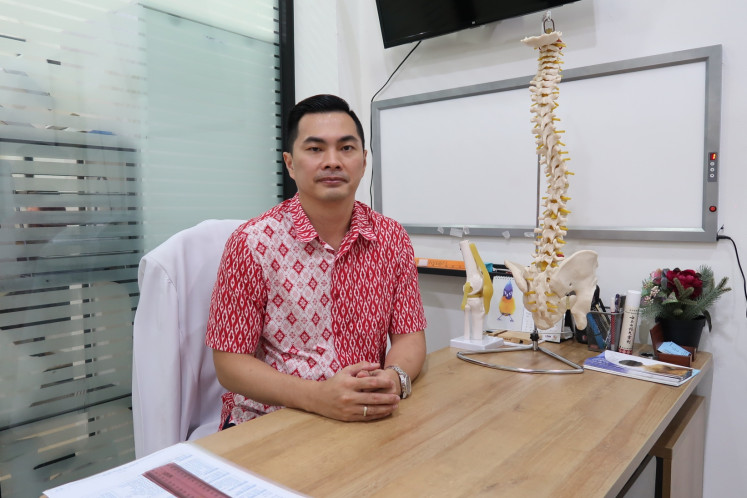
Dr Budi Sugiarto Widjaja studied the Schroth Method in Germany. Dr Budi Sugiarto Widjaja studied the Schroth Method in Germany. (JP/Jessicha Valentina)
In Indonesia, the method was introduced by Dr Budi Sugiarto Widjaja in 2015, who studied the treatment in Germany. 
During the Schroth Best Practice seminar at the clinic on Feb. 23, Budi said scoliosis usually appeared during puberty, between ages 10 and 14, and 80 percent of the cases were idiopathic, meaning the causes were unknown.
Budi stressed the importance of early detection, saying that it was best to do the treatment during puberty, especially if the patient also used The Gensingen Brace by Dr Weiss® , a scoliosis brace made from polythene, which is designed for specific curve patterns, following the user’s posture.  
“Scoliosis is manageable,” he said. 
However, the Schroth Method is also suitable for adults with scoliosis who want to correct their posture.  
The method features various exercises, including physiology and activities daily living. 
During the treatment, the patient will learn how to correct their posture while standing, sitting, walking and even breathing.  
“The method shift the [bones], not bend it,” said Budi, adding that it targeted specific muscle based on the curvature of the spine. 
Budi said the Schroth Method was also useful for adults. “After puberty, the development of scoliosis might slow down. However, if [the patients] do not know how to maintain the right posture, it could get worse,” he said. (asw)


Source : Jakarta Post , 24 Feb 2019